Physical Media Consumer Guide, Too Late For A Holiday Gift Guide Edition
Sorry about that, but you can buy stuff all year

Alraune/Student of Prague (Deaf Crocodile)
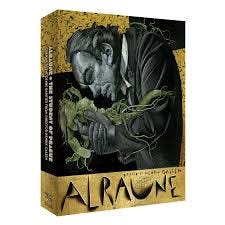
Man. I’ve been extremely curious about Alraune, particularly this 1927 version (the messed-up story has been filmed more times than you might reckon) since reading about it in a Tom Milne-edited film encyclopedia, which I stupidly gave away, or something years, ago. So the deal is, this criminal gets hanged, his ejaculate seeds the ground below him, a mandrake grows from it, and a “mad” scientist uses the mandrake to create, kinda-sorta Frankenstein style, the ideal woman. Not ideal in virtue but in sex appeal. Here, in director Henrik Galeen’s vision, said woman is played by Brigitte Helm. You know her as the human saint/robot vamp in Lang’s Metropolis, of course, and she gets her freak on in a not dissimilar fashion here. The movie is a Fantastic hoot, with the Golem himself, Paul Wegener, as the scientist. The Student of Prague, a William Wilson riff that had been made in 1913 with Wegener in the title role, is here rebooted with Conrad Veidt in the title role, which, just as Helm’s presence in Alraune justifies a recommendation, makes it eminently worth your time. It looks a little more beat-up than Alraune but it’s quite a movie, it really takes its time getting to the driving conceit and allows Conrad to really bask in weltschmerz before letting his id run wild. Startling mirror effect 55 minutes in. The other components of the movie slap too. Deaf Crocodile is emerging as one of the crucial outfits Of Our Time. — A+
Asylum (Severin 4K Ultra disc)
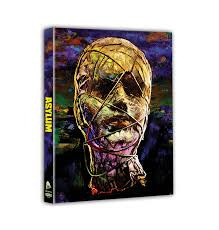
I was a mere lad and beardless youth when I saw this for the first time at Bergenfield’s Palace Theater in the late fall of 1972 with my then-bestest moviegoing pal Joseph Failla. A horror anthology right up our alley, as we dug cheap thrills and had short attention spans. Actually our attention spans were pretty good for our age but you get the idea. Having dug the hell out of Tales From The Crypt in the spring of the same year, our blood was up for the Roy Ward Baker-overseen followup (Tales was helmed by erstwhile cinematographer Freddie Francis; veteran director Baker was an oft-inspired journeyman, but we had no idea of that at the time). It did not disappoint, in part because the Robert Bloch storis were all better than solid. Gnarly stuff for a PG-rated movie — wrapped in butcher paper or not, those disembodied limbs coming to life were pretty convincing. Severin’s 4K edition was hence a no-brainer buy for this sailor. It looks terrific and delivers like mad. Doesn’t hurt that the cast contains gorgeous Barbara Parkins, iciliy beautiful Charlotte Rampling, better-than-credible Britt Ekland and The Immortal Peter Cushing among others. The viscera imagery capping the obi episode still icks me out after all these years, though. I also think it doesn’t work, but this is a possible chicken-and-egg objection. — A+
The Curse of Frankenstein (Warner Archive)
Hammer studios is on a roll with restorations nowadays, and not just the out-and-out horror stuff; Terence Fisher’s 1953 sci-fi picture Four Sided Triangle, in which luscious Barbara Peyton gets cloned, is a complete keeper. (I took Peyton’s harrowing memoir I Am Not Ashamed off my shelf after watching this, and she doesn’t mention the movie at all; she writes of flying to England, but nothing about what she did there, besides, you know, drink and stuff.) This essential item is here presented by Hammer and the Warner Archive in tandem, and it’s a great dual effort. (It’s nice to see, almost 10 years after the fact, some manufacturers taking, well, my advice.) Some would say that the honey-toned speaker Christopher Lee was ill-used in a title role (Frankenstein, not the curse…okay, FRANKENSTEIN’S MONSTER) that had him grunt and growl, but his feral monster is unforgettably antisocial. The 4K disc presents the picture in three, count ‘em, three, aspect ratios, and like Tim Lucas, I favor the 1.37 framing. But it’s great to have a few to choose from, depending on…I don’t know, your geometric mood? — A+
Saga Erotica: The Emmanuelle Collection(Severin)
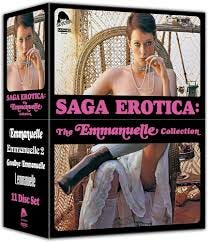
How much Emmanuelle, or Emmanuelle, does one person need in their life? The answer from this box set is A LOT. You get the 1974 Just Jaekin softcore groundbreaker and two sequels, all starring Sylvia Kristel and the last scored by Serge Gainsbourg. Despite the fact that Pierre Bachalet does a very credible Gainsbourg impression in the first film, the filmmakers threw the OG some work anyway. The score in the first film ripped off Crimson’s “Lark’s Tongues In Aspic” in a way that’s still pretty funny, and Robert Fripp sued (look up the story, which is also pretty funny) and he now gets royalties, and rightly so. The very comely Kristel often looks as wide-eyed as Kurtzman and Elder’s Little Orphan Fanny as she is introduced to all manner of softcore hijinks, and the movie seems to introduce to mainstream audiences a lot of dumb sex cliches like the Mile-High Club, fingerbanging after playing squash, that sort of thing. Bresson fans will go into shock upon seeing Marika Green, the saintly Jeanne of Pickpocket, here playing the worldly Bee, who initiates Emmanuelle into sapphic luv. Whoo-hoo. The 4K image is great throughout, you really get the detail on that mosquito netting they’ve got up everywhere. They’re in the tropics, you see. I won’t live long enough to watch all the extras. Inspirational dialogue: “Your wife has great tits.” — A+
Hitch Hike (Powerhouse)
This nasty, slightly Cravenesque Italian thriller doesn’t reach the lows of To Be Twenty, and what could, but it’s still pretty raw. Why do we continually underrate Franco Nero? As for David Hess, he’s almost as repellent as he was in Craven’s Last House on the Left, while Corinne Clery provides both a (provisional) rooting interest and daunting beauty. This is a movie best seen for the first time cold, because it;s a true jaw-dropper. It’s not a spoiler to not that, speaking of Bresson, there’s an interesting Au Hasard Balthazar ripoff at the end. Extras are great, including a ninety minute making-of doc with Nero, Clery, Hess, et alia. My life advice for you, incidentally, is to find someone who loves you as much as this film’s director loves slow motion car crashes down steep hills. Inspirational dialogue: “I’ve never met an Italian yet who could hold his booze.” —A+
Lovely To Look At (Warner Archive)
An ostensible adaptation of Roberta, this is one of those non-Freed-Unit MGM musicals that aimed to deliver audiences everything but the kitchen sink. Comedy via Red Skelton, super-professional singing via Kathryn Grayson (who’s also a knockout, seriously) and Howard Keel, snazzy dancing from Marge and Gower Champion (and they really tear it up), moxie via Ann Miller, Gabor via Zsa Zsa. And the usual egregious Hollywood misuse of Marcel Dalio. Dazzling Technicolor imagery, peppy direction from Mervyn LeRoy, even peppier direction from Vincente Minnelli, who takes ver for the eye-popping choreographed “fashion show” finale that’s worth the entire price of admission. Extras include a good Tom and Jerry and a goofy short that asks, among other things, “Have you ever wondered whether women were worse drivers than men?” — A
The Master of Ballantrae (Warner Archive)
Good points: More glorious Technicolor in a film starring Errol Flynn and directed by one of the co-directors of The Adventures of Robin Hood. Not Michael Curtiz though. And it’s 1953, not 1939, and Flynn is aging. You get lots of cutaways during Flynn’s sword fighting scenes, and many shots in which he’s clearly replaced by a double. Happens to the best of us. Wait — Flynn was just 46 when they shot this. He did live hard, remember. And he’s still Fynn, and the supporting cast is great — Roger Livesey and luscious Yvonne Furneaux among them. Not deathless but fun. — B+
Murderock (Dancing Death) (Vinegar Syndrome)
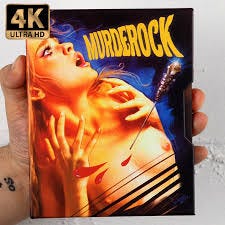
It has already been much remarked upon that in terms of grotty gore, this is way more subdued than practically any other horror film directed by Lucio Fulci, who’s otherwise notorious for set pieces in which, for instance, a hapless character regurgitates all of their internal organs. (Watch out for that liver!) Here, the murders of leotarded female dancers are committed by way of a long straight pin, inserted in an at least mildly provocative area. The overall effect is credibly sleazy in spite of the ostensible restraint. Keith Emerson’s score is mostly electric prog but he does get to break out the barrelhouse acoustic piano stylings every now and again, what a guy. The film is set in Brooklyn and there are a few shots of the promenade on the Height, spitting distance from my Uncle Jack’s old house AND the weird house from Winner’s The Sentinel. For those with a jones for such material it’s a good time, looking fine…packed with extras (on the BR), a very chipper and informative Trey Howarth commentary taken from an earlier Scorpion release —A
The Racket (Warner Archive)
This is a rather shockingly flat remake of Milestone’s 1928 The Racket. I know this to be true because shortly before watching it I actually, with my treasured collaborator Farran Smith Nehme, recorded a commentary for what promises to be a great edition of the original ’28 film, directed by Lewis Milestone, for the fine folks at Flicker Alley. This 1953 version, directed by John Cromwell, pairs Roberts Mitchum and Ryan, fresh from Crossfire, in a film much less urgent and/or pertinent. Watching these guys go at it is always a pleasure but man wait until you see the Milestone, with Lewis Wollheim portraying a real-life Golem, more or less. — B
A Summer Place (Warner Archive)
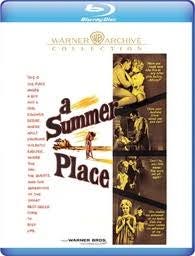
True cinephiles treasure Delmar Daves melodramas as much as they do his Westerns, and this 1959 number, with gorgeous Monterey locations and both the juvenile (Sandra Dee and Troy Donahue) and veteran (Richard Egan, Arthur Kennedy, Dorothy Maguire) stars in their respective primes, is the most well-known, and probably rightfully so, although we’ll keep hoping the Archive reviews Parrish and more. Like myself, you may find yourself talking to the screen and asking Sandra Dee, “You did WHAT?” Her insouciance is only bolstered by her peaches and cream complexion rndered inm yet again, glorious and especially vivid Technicolor. —A
MISCLLANY
FIlm Movement is doing its customary thing with a better-than-watchable disc of William Castle’s House on Haunted Hill (ever the opportunist, he mixed around with the title of Shirley Jackson’s classic Haunting of Hill House and beat Robert Wise to the punch of his immortal adaptation; Castle’s film is, as you’d expect, a zippy slice of cheese with most of the exemplary cast — Vincent Price, Elisha Cook, Jr., Richard Long (doing an expert albeit possibly inadvertent impression of Gig Young) — fully in on the joke. FM also does right by the more obscure 1949 The Judge, with Gunsmoke stalwart Milburn Stone at his most beady-eyed as a corrupt lawyer bent on vengeance. Universal’s mammoth Alfred Hitchcock Presents box set is kind of shockingly plain as presentations go, but it affords you the opportunity to watch, say, “Man From The South” anytime you want with minimal fuss. Finally, Cineverse bundles two films directed by and starring Steven Luke, concerning the Battle of the Bulge. The cover helpfully states “Based on a True Story.” Wunderland and Winter War feature Tom Berenger, Billy Zane, and Luke himself. Luke’s ambition is commendable, although his low-budger pragmatism (shooting in South Dakota, for instance) doesn’t yield entirely inspiring results.
The Deaf Crocodile Alraune/Student of Prague release sounds incredible, especially with that Wegener connection across both films. I've been chasing rare silents from that era and the mirror effect you mentioned in Student of Prague at 55 minutes is exactly the kind of technical innovation that gets overlooked when people dismiss early cinema as primitive. Also appreciate the honesty about Asylum holding up after 50+ years, sometimes those anthology horror films from the 70s feel dated but Bloch's writing aged way better than most of his contemporaries. The 4K treatment on these older Technicolor films keeps impressing me tho, that detail on Lovely To Look At's fashion sequence must be stunning given how much Minnelli packed intothose frames.
And with François Leterrier, the hero of A MAN ESCAPED, the director of GOODBYE EMMANUELLE.