Montana
A formative experience with Valerie Perrine

I was a precocious kid. In grade school I was informed that I could read at a much higher age level than my peers, and I took that to heart and started in on Burroughs and Genet and Anthony Burgess. A Clockwork Orange took me a while even with the Nadsat glossary (compiled and published against Burgess’ wishes, I read somewhere or other). Kurt Vonnegut was rather more congenial. I believe I may have actually read Cat’s Cradle before I got to Slaughterhouse - Five, but both books made huge impressions on me, and so did Breakfast of Champions, published in the wake of Vonnegut’s huge success with Slaughterhouse - Five and reflecting, among other things, the extent to which that success roiled him despite raising his standard of living substantially.
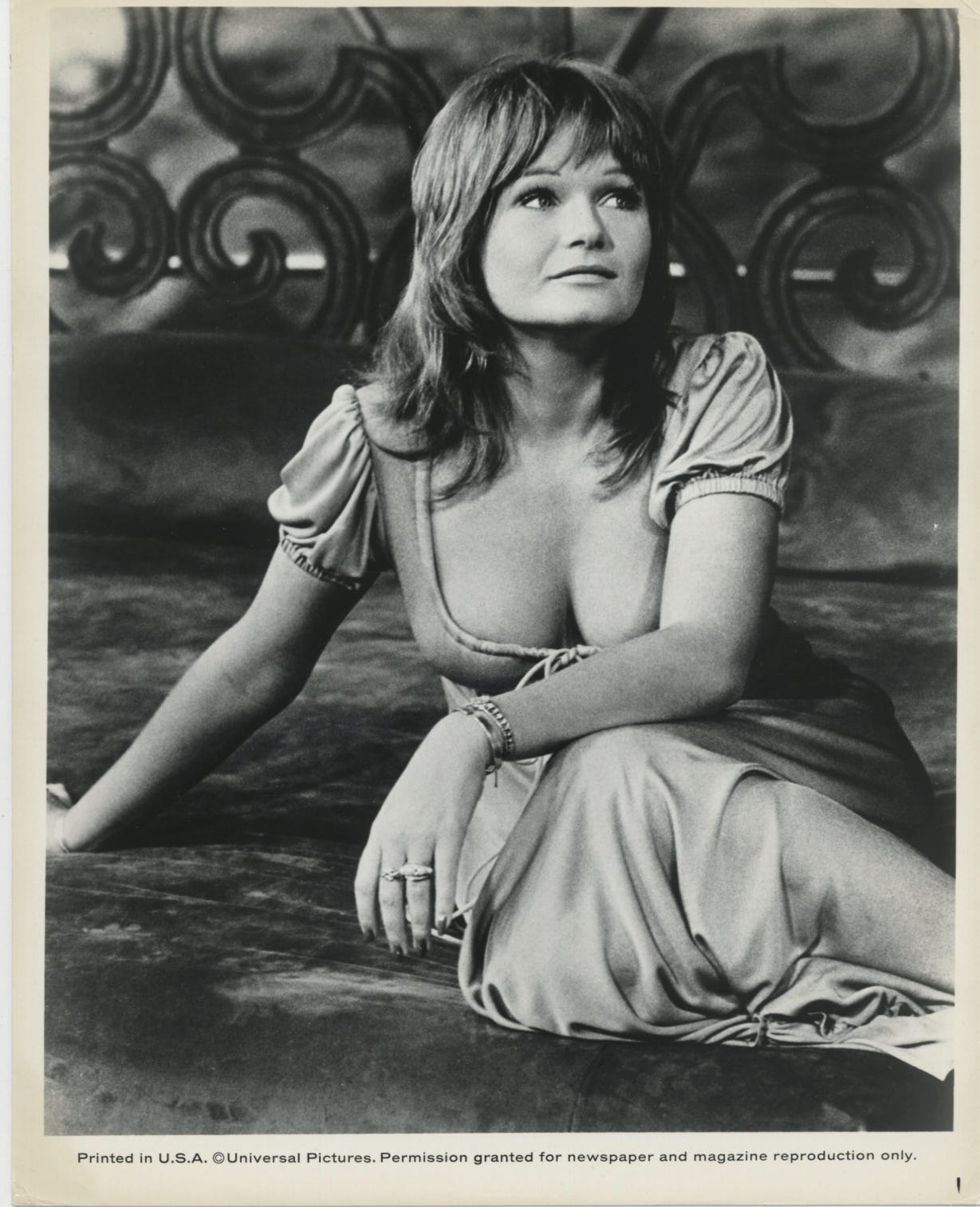
In any event, when the film version of Slaughterhouse - Five came out in March of 1972 — 54 years ago, yeesh — I was quite keen to see it, but of course being twelve I needed an adult guardian to see it with, as the film was rated R. It was so rated for its depicted events and themes, of course — the atrocities World War II, what was not yet known as PTSD, that sort of thing — and also due to nudity, specifically the nudity of actress Valerie Perrine. Perrine played Montana Wildhack, the onetime Playboy Playmate and adult movie actress abducted by Tralfamadorians to mate with the novel’s unstuck-in-time hero Billy Pilgrim. My dad wasn’t going to take me — last time I’d asked him to bring me to a movie was a screening of Zero for Conduct at some Bergen County arts center, and when we got there we were told that the print of the Vigo film was unprojectable and they were going to screen Joris Ivens’ Le Mistral instead, and I cried. So I enlisted my Uncle Richie, who was 12 years older than me and a Vietnam vet (he got lucky and spent most of his tour working at a PX, and remained an ace cocktail mixer for the rest of his life), who was pretty game, and we enjoyed the movie a great deal. It was my own first experience of R-rated material and I can’t say I was displeased. Perrine was more than a beguiling physical presence though. Her portrayal of Montana is warm, putting across the character’s optimism and kindness without overstatement. She seemed very, well, natural. Gorgeous as she was, she seemed approachable in a way that few if any other screen sirens did.
Perrine was a skilled actress that Hollywood didn’t really know what to do with. That’s not to say she didn’t have a career — she did, and it included several very good and enjoyable films, but watching her in those Superman films, yes, she was a commendable screen comedienne, but like the song says, is that all there is? Even in a meaty dramatic role in Tony Richardson’s The Border, she’s subordinate to Jack Nicholson.
Back to Vonnegut. One reason I took to him so enthusiastically as a kid was because, well, he was so readable. His prose style was straightforward, his tone coherent and direct. Behind every “So it goes” in Slaughterhouse - Five, there’s an anger that Vonnegut wants to rise above. Even as a mere kid, I got the sadness in the writing, so hard that when I think about it now it cuts through me. I think of the bit in Breakfast of Champions when Hoover and Kilgore Trout are in an ambulance and they pass a billboard sign that reads: “IT IS HARDER TO BE UNHAPPY WHEN YOU ARE EATING CRAIG’S ICE CREAM.” It’s somehow tragic!
When Perrine’s Montana first pop’s into Billy’s Tralfamadore dome, she’s wearing a heart-shaped locket that is not elaborated on. In the book, Vonnegut gives us a drawing of the locket resting between Montana’s breasts, and tells us that on one side of the locket is a picture of Montana’s alcoholic mother, and on the other side is the Serenity Prayer: “God grant me the serenity to accept the things I cannot change, courage to change the things I can, and wisdom to know the difference.” In an essay reprinted in the e-book Vonnegut by the Dozen and reprinted in The NAtion in 2013, Vonnegut writes: “What has been America’s most nurturing contribution to the culture of this planet so far? Many would say Jazz. I, who love jazz, will say this instead: Alcoholics Anonymous.
“I am not an alcoholic. If I was, I would go before the nearest A.A. meeting and say, ‘My name is Kurt Vonnegut. I am an alcoholic.’ God willing, that might be my first step down the long, hard road back to sobriety.”
Vonnegut was not an alcoholic but he was a legendary smoker. When he did a reading at my college in the late ‘70s, he was practically shrouded in Pall Mall fumes, the aroma mixing pleasantly with his tweed. He was not, I think, asked about the film adaptation of Slaughterhouse - Five, and the Jerry-Lewis-starring riff on Slapstick was yet to come. The man was friendly, and encouraging to student writers in a way that was both optimistic and realistic (subsequent college speakers were a bit different; I remember Joseph Brodsky getting a little exasperated at having to explain to an interlocuter that poems were made of words, not feelings, and Edward Albee was very “don’t try this at home, or at all, really”). Despite his habit, he lived to the relatively ripe old age of 84, after having gone one on one as a performer with Rodney Dangerfield in 1986’s Back To School and seen Breakfast made into a picture, one that is still controversial to this day — I hated it, but Richard Brody’s writeup of it makes me want to revisit it. Not in a hurry, however. I’ll almost certainly prioritize, say, the upcoming Criterion edition of Bob Fosse’s Lenny, which features another indelible Perrine performance.