Flynn X 3
The effortless insouciance of the king of cinematic derring-do

Way back in 2004, I had the privilege of interviewing Olivia De Havilland, who was 88 at the time. (God love her, she lived to be 104.) She didn’t seem more than 60, or 50 even, and was utterly gracious and delightful and refreshingly frank. She had fond recollections of her frequent costar Errol Flynn and was ultimately a little contrite at the fact that she didn’t take him all that seriously when he was alive. She spoke of sitting down with Bette Davis some time in the 1950s or ‘60s and watching The Private Lives of Elizabeth and Essex together, and being moved by Flynn’s performance in the movie. He really was “very good,” they both agreed, and regretted not having let him know at the time.
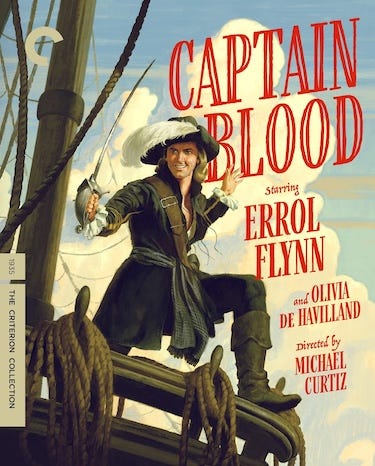
Three new physical media releases are delightful opportunities to see just how very good he was. Flynn wasn’t put on this earth to be anyone’s go-to guy for tortured introspection; he never got his own In A Lonely Place because there was no call for him to (closest he got was playing his role model John Barrymore, in serious dissolution mode, in Too Much, Too Soon). His apogee, the movie that set one archetype for his roles to come, is in Michael Curtiz’s 1935 Captain Blood, costarring De Havilland, now out in a splendid Criterion edition featuring an essay by my Bunny Friend Farran Smith Nehme. (There’s also a commentary from the great Alan K. Rode, whose thorough and entertaining biography of Curtiz greatly assisted in my recuperation from kidney stone surgery almost ten years ago.) The lustrous transfer really makes you appreciate the brief phase in Flynn’s career when his philosophy was, “If I have one life to live, let me live it as a blond.” He looks so sad when he’s put on trail at the beginning, and so dashing for the rest of the picture, which is ridiculously entertaining. And actually features, rather incongruously, the cutest ending you’ll ever see in a Flynn picture, or a pirate picture, or anything.
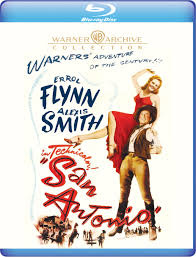
Warner Archive presents two goodies: 1945’s San Antonio, costarring Alexis Smith and directed by Raoul Walsh. Curtiz and Walsh were the two Flynn directors par excellence, steering Flynn through Westerns, period adventures, and World War II pictures. San Antonio actually features a character observing “There goes an empty horse,” which I always thought was a Curtiz line (if you know David Niven’s memoirs, you know). It’s easy to see why this was the most successful of Flynn’s 1940s pictures — it has beautiful Technicolor, it goes down super easy, Alexis Smith is a honey, etc. I’ve heard a story that on the set of The Age of Innocence Martin Scorsese was perturbed that Winona Ryder had never seen a movie featuring her costar Alexis, and that Scorsese arranged for the young ‘un to sit through a bunch of the legend’s pictures, and I hope this was one of them. It’s a honey.
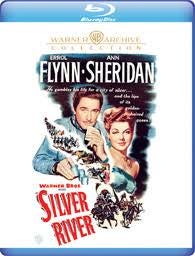
Silver River was made in 1948. It’s the last of the Flynn/Walsh teamups, perhaps in part because Walsh had a hard time keeping Fynn in line and engaged with the work. Not just Flynn — his costar Ann Sheridan liked a drink, too. (Flynn would die in 1959, at the age of 50; Sheridan passed in 1967, at the age of 51. Aiiiieee. ) It starts off with a bang with a furious chase and the burning of some money. Walsh injects his trademark dynamism throughout. When Flynn rides into the town where most of the action takes place, there’s a fist fight going on right next to the hitching post to which Flynn will tie his horse. Flynn’s character here is more charming fourflusher than action hero, and indeed, the movie ends with his character stopping a gun battle rather than winning one. And for the sake of saving Barton McClane, at that. It’s still rather great fun and the disc looks terrific.